

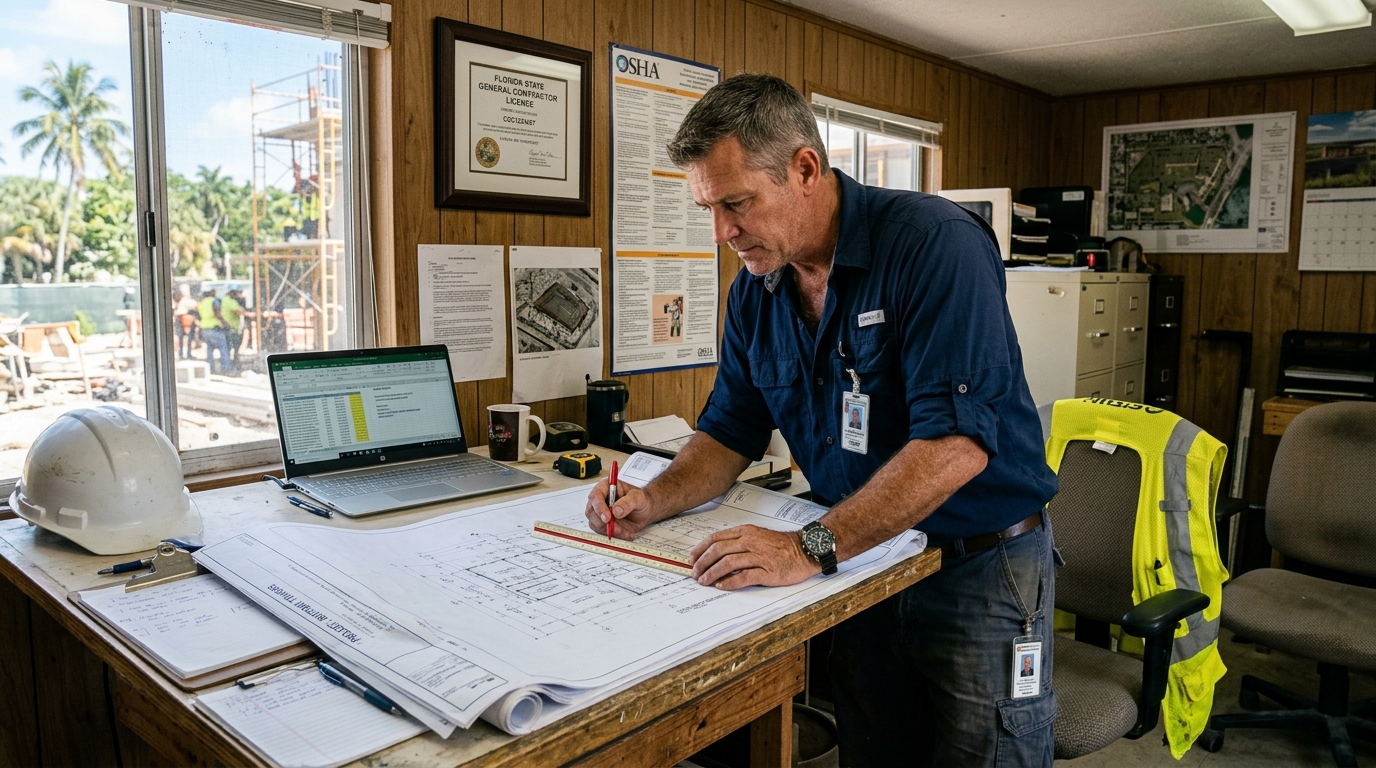
Why Direct Permitting Matters: Eliminating the "Paper Broker" Risk
In South Florida's construction landscape, an alarming number of sales outfits operate as "paper contractors." These entities lack their own certified qualifiers, instead renting licenses from retired builders or hiring third-party "permit expediters" who have no presence on the physical jobsite.
When you hire Planet Construction, your permit is pulled under Genti Kraja (John), holder of Florida Certified General Contractor license CGC1517295 and Certified Roofing Contractor license CCC1329271. The qualifier whose name is recorded with the city or county building department is the exact builder inspecting your jobsite and meeting the municipal building inspector in person.
Our 6-Step Municipal Permitting & Inspection Lifecycle
From initial architectural review through the issuance of your official Certificate of Completion, we handle every administrative and engineering milestone:
Step 1: Engineering Review & NOA Compilation
We compile stamped engineering calculations, wind-uplift test reports, architectural schematics, and official Florida Product Approvals / Miami-Dade Notices of Acceptance (NOAs) for every material used.
Step 2: Notice of Commencement (NOC) Filing
Under Florida Statute § 713.13, any project valued over $2,500 (or $5,000 for HVAC/roofing) requires a recorded NOC. We prepare, notarize, record the document with the County Records division, and post it prominently on site.
Step 3: Building Department Plan Review & Permit Issuance
We submit package documentation directly into municipal electronic plan review portals (e.g., Fort Lauderdale, Hollywood, Pompano Beach, Boca Raton, Miami-Dade ePermitting), answer plan examiner comments, and secure the approved building card.
Step 4: In-Progress Rough Inspections
Depending on scope, municipal inspectors must verify work before it is covered. Examples include roof deck re-nailing (6-inch fastener spacing), self-adhering secondary water barrier underlayment, rebar replacement in structural concrete, and framing anchors.
Step 5: Final Engineering & Municipal Inspection
Upon construction completion, John Kraja or our field project managers walk the site with the municipal building inspector to review finished assemblies, edge flashing, drainage, and safety protocols.
Step 6: Closed Permit & Certificate of Completion
We provide you with the official municipal sign-off and closed permit documentation, which is vital for insurance premium discounts, clear title transfers, and association records.
The Devastating Costs of Unpermitted Construction in Florida
Some property owners are tempted by unlicensed handymen offering to perform roof replacements or concrete repairs "off the books" to bypass municipal permit fees. In Florida, this gamble carries severe repercussions:
- Zero Insurance Coverage: Property insurance carriers can legally deny claims for storm damage or water intrusion if forensic investigators discover the roof or opening was installed without an approved municipal permit.
- Double Permitting Fines & Code Enforcement Liens: Building departments assess up to 400% in penalty fees for unpermitted construction and can place encumbering liens on the property title.
- Mandatory Destructive Testing: If a city red-tags unpermitted work, they frequently require the owner to hire a structural engineer to cut open finished walls or tear off completed roofing layers to inspect concealed fasteners.